NXP Technology Days · Automotive demo
AI That Knows When Not to Act: Trustworthy Perception at the Edge
A deployed perception model can stay confident even when the scene contains something it has never seen, or when its own camera input degrades. Capsa adds a risk signal alongside the prediction, so an edge system can tell a familiar input from an unfamiliar one — and decide whether to proceed, verify, reroute or escalate rather than acting blindly.
Running live on the i.MX 8M Plus NPUfull INT8TensorFlow Lite 2.19 with the NXP VX delegate (eIQ)Linux BSP LF6.18.2Probe scoring on two Cortex-A53 cores
[ 01 ]
The result at a glance
81% fewer missed than the model’s own confidence, at a 5% false-alarm threshold
i.MX 8M Plus · INT8
MUAD-OOD synthetic driving scenes; threshold flags 5% of clear-scene pixels
i.MX 8M Plus · INT8
risk computed in a single pass, plus ~4 ms of scoring on two Arm cores
i.MX 8M Plus NPU
These are live demonstrations on public driving data (A2D2) and a scene we built and captured ourselves; the measured figures also use the public and simulated datasets listed under Methodology. They illustrate the behavior of the risk signal; they are not production benchmarks, yield figures or safety certifications.
[ 02 ]
Why perception fails in a vehicle
In a vehicle, a perception model that is confidently wrong is a safety liability, and the hardest failures are the ones the model never saw coming. Out-of-distribution conditions are among the most common causes of perception degradation in the field: an unfamiliar object in the road, or a camera degraded by fog, rain, glare or a fouled lens.
The usual answer is redundancy: more sensors, sensor fusion, a fallback path. That is necessary, but it has a known gap. Fusion can only recombine what the sensors provide, and against a common-cause failure — the model confidently wrong about something it was never trained on — duplicated sensors or models often fail the same way at the same moment, and the system cannot tell which input to trust.
A risk signal that flags from within the model addresses that blind spot. It recognizes the unfamiliar object and the failing camera before the system acts on them, and turns that into a decision:
Act on the prediction — the input is familiar.
Flag for review before acting.
Fall back to another model or sensor.
Hand control to the driver.
Because Capsa runs live on the edge, that judgment happens on the device, inside the control loop, in the fraction of a second it has.
[ 03 ] Demo 1 · vacuitic uncertainty · Neo
Foreign object detection
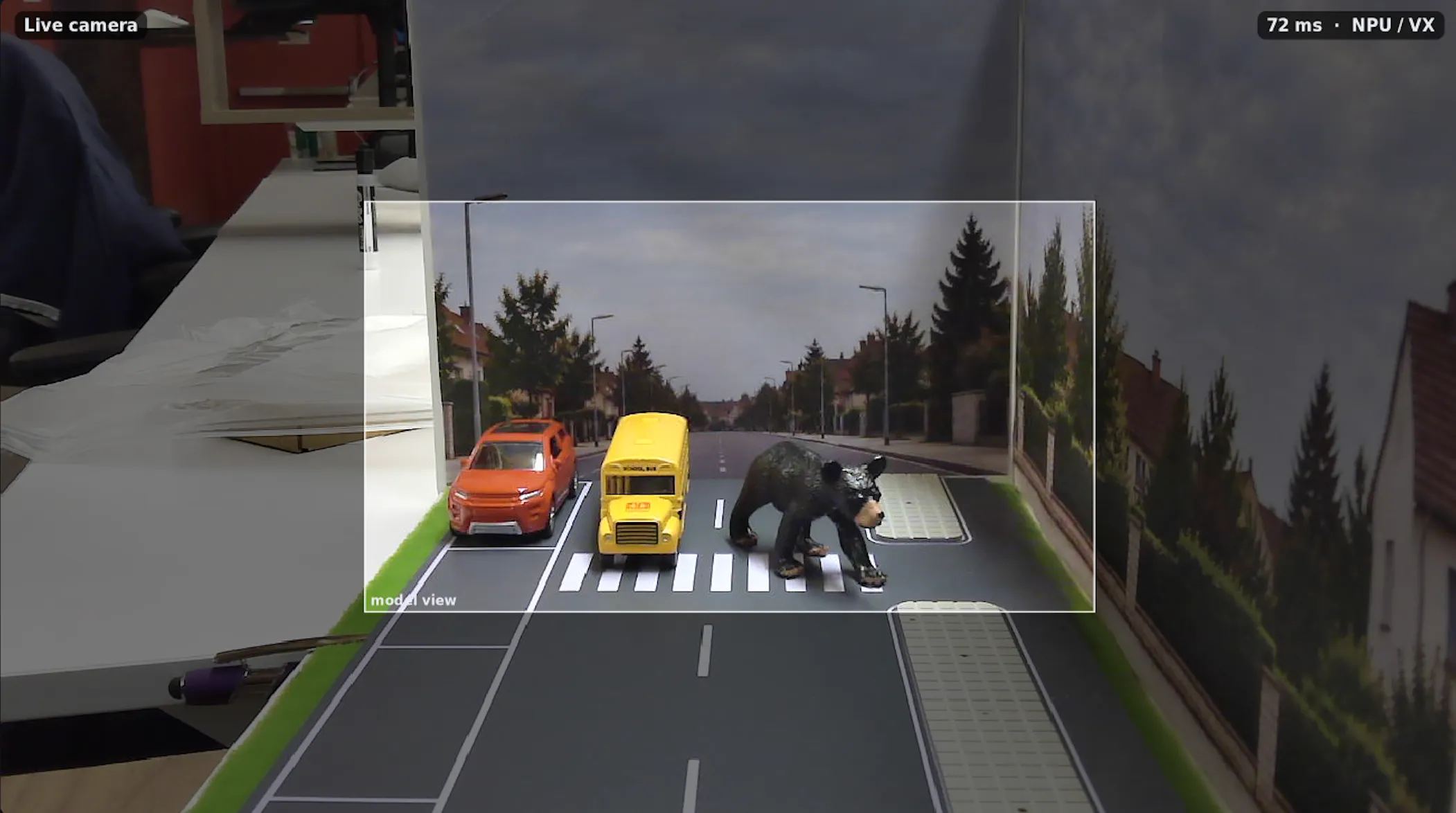
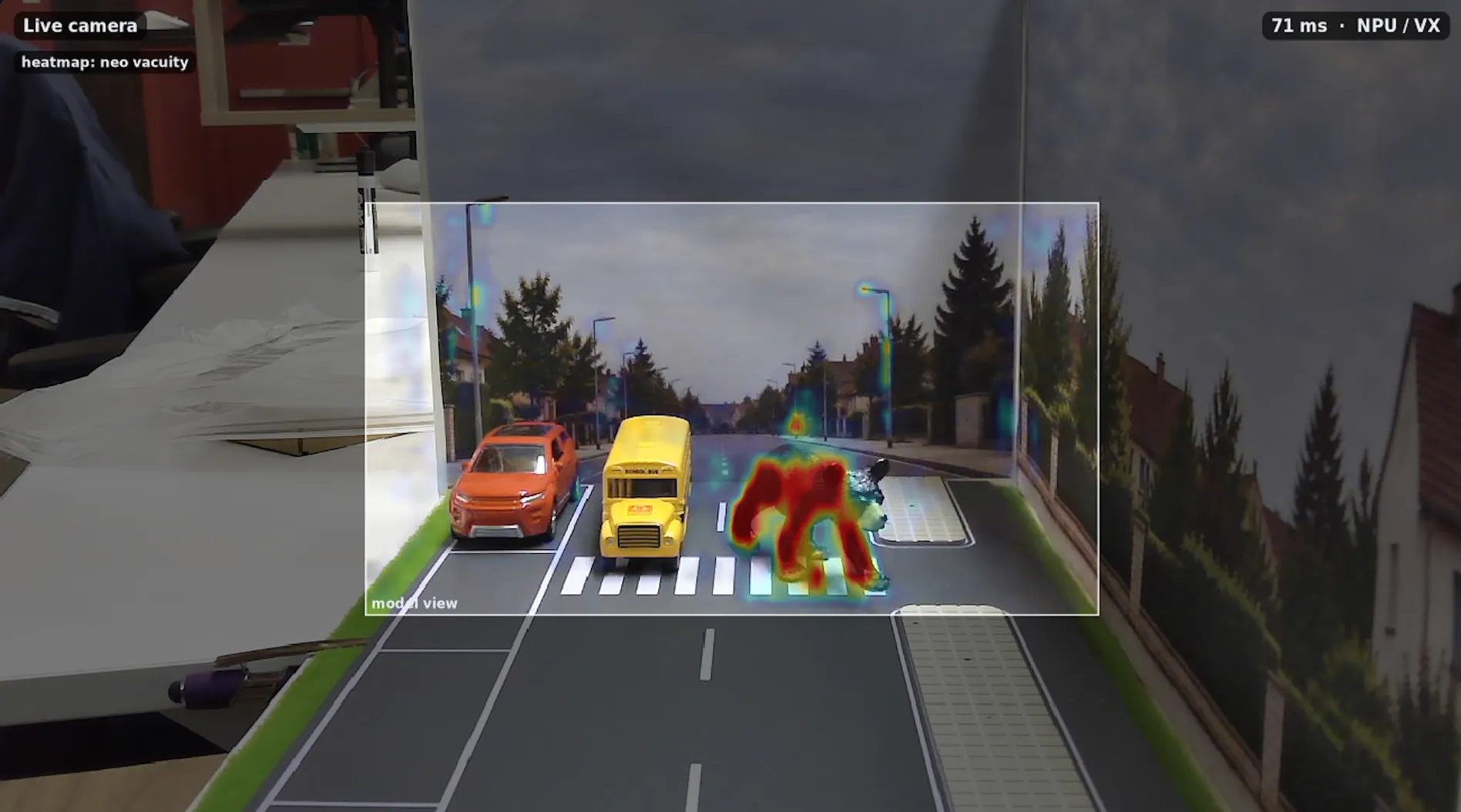
A camera watches a road scene, and the model flags anything it does not recognize. Place a car on the road and the model is comfortable: it has seen plenty of cars, so the scene stays calm. Place an animal in the road — something it was never trained to expect — and the region lights up red. The model is signaling, in real time, that this input is out of distribution and its read of it should not be trusted.
The live flag
The risk signal is computed for every pixel and shown as a heatmap over the camera feed, so an unfamiliar object lights up where it sits. When a region’s average risk passes set multiples of its clear-scene level — 1.25× for elevated, 1.5× for high risk — the region is flagged and the verdict becomes escalate to a human. In this demo the region is the full frame. In a real deployment, the region, the thresholds and the resulting actions are user-defined operating points.
Measured performance
13 vs 56 of 59 objects missed, with the heatmap threshold set so 5% of clear-scene pixels are flagged
i.MX 8M Plus · INT8
i.MX 8M Plus NPU
PIDNet-S driving segmentation with Neo · NXP i.MX 8M Plus · INT8 · MUAD-OOD (synthetic driving scenes), 59 unfamiliar objects. On real photos (RoadAnomaly, SMIYC), Neo ranks unfamiliar-object pixels better than the model’s own confidence (AUROC 0.71 vs 0.59 and 0.72 vs 0.53).
[ 04 ] Demo 2 · epistemic uncertainty · Probe
Degraded-input detection
Here the question is not what is in the scene, but whether the camera itself can be trusted. A failing sensor, a fogged or wet lens, or glare all degrade the image the model sees, and this demo flags that degraded input before the system acts on it. The demo runs a real driving clip, and you control the image quality with a blur slider. At first the picture is clean and the risk signal stays low — the verdict reads trusted. As the input is blurred, the risk signal climbs: once it crosses the warning threshold the verdict flips to degraded. The model recognizes that its own input can no longer be relied on.
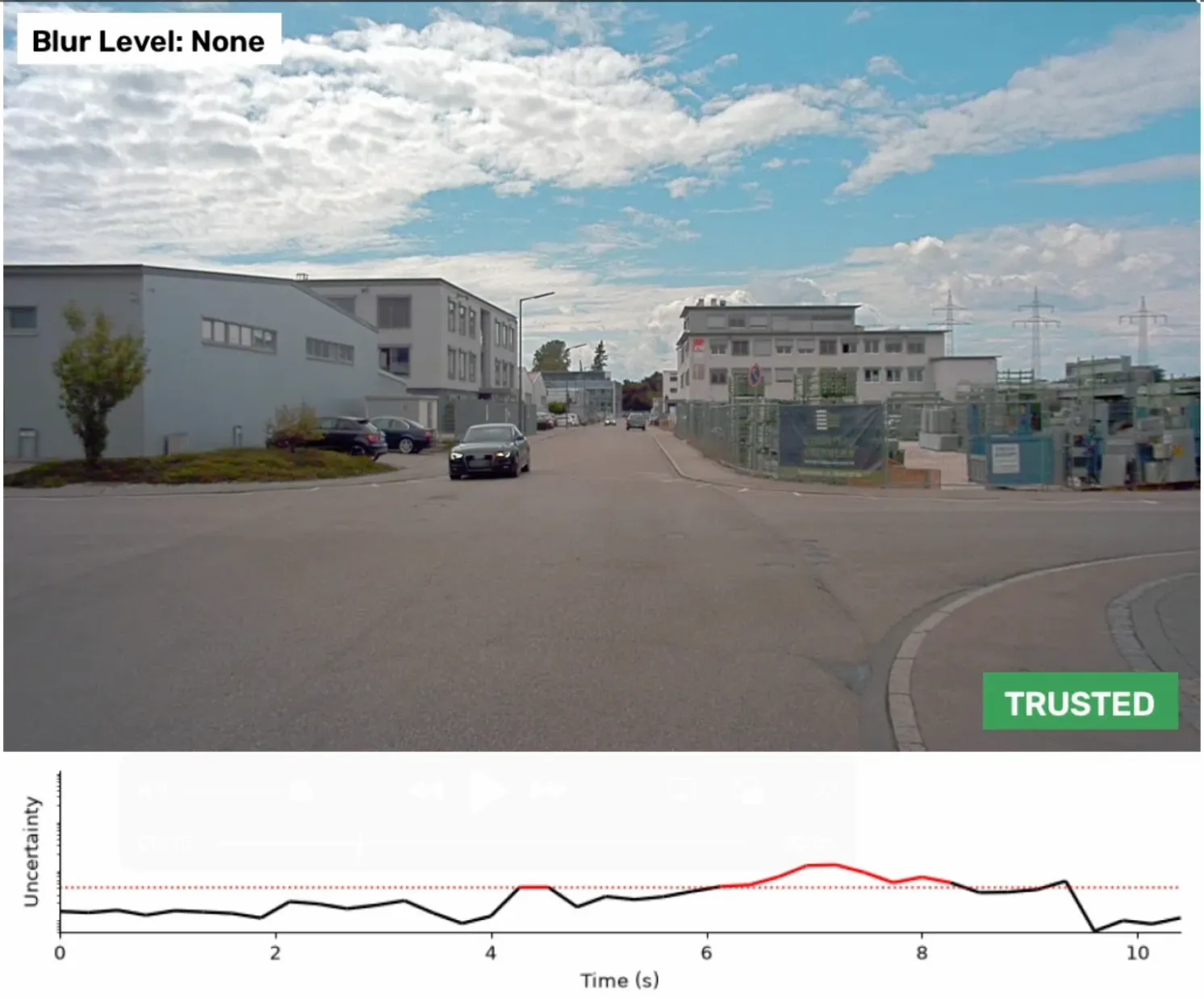
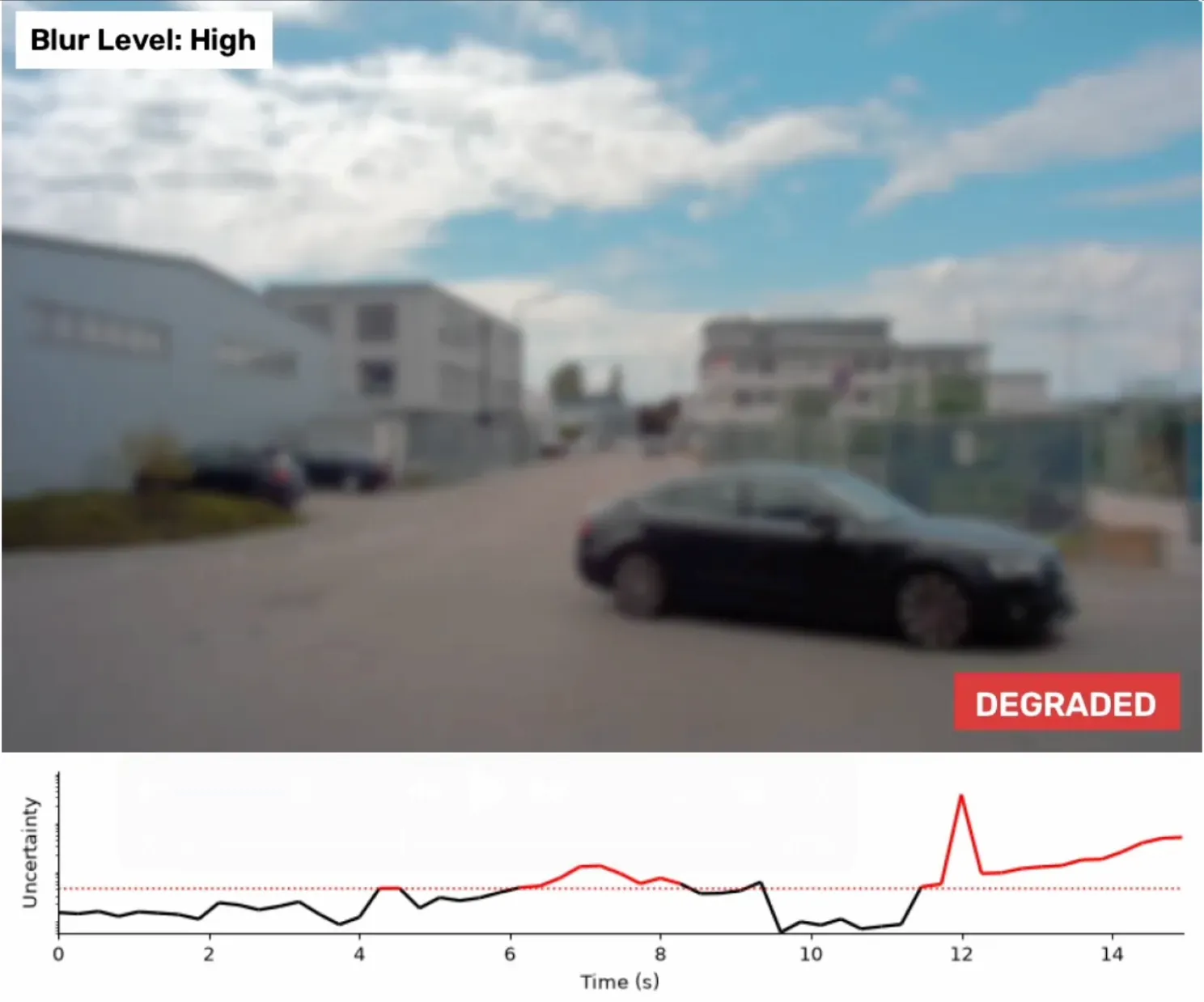
Driving frames from A2D2: Audi Autonomous Driving Dataset (Geyer et al., 2020, arXiv:2004.06320), used under CC BY-ND 4.0.
Measured performance
81% fewer missed than the model’s own confidence (3 vs 16 of 105), at a 5% false-alarm threshold
i.MX 8M Plus · INT8
plus ~4 ms of scoring on two Arm cores
i.MX 8M Plus NPU
Across 9 degraded conditions, Probe missed 57% fewer degraded frames than the model’s own confidence (28 vs 65 of 315). With heavy blur it missed 69% fewer (4 vs 13 of 40). On real fog, the model’s own confidence missed 4 frames and Probe missed 16.
PIDNet-S driving perception · NXP i.MX 8M Plus NPU · INT8. 380 frames (A2D2 clean and blurred, CARLA and MUAD simulated weather), 105 failures. A failure is a frame whose mIoU falls below half the clear-weather average.
The degraded warning triggers at the 95th percentile of clean-frame scores (5% false alarms on clean frames, by design); high risk at 1.5× the clean average. In a real deployment these are user-defined operating points chosen to match the application’s tolerance; no single correct value is claimed.
[ 05 ]
What it costs, and how well it works
Measured on the i.MX 8M Plus NPU, full INT8 (TensorFlow Lite 2.19, NXP VX delegate), as the mean of 100 runs after warm-up, in 3 alternating rounds, against each demo’s own unwrapped export.
| Cost | Unwrapped | With Capsa | Difference |
|---|---|---|---|
| Demo 1 (Neo) NPU inference time | 52.8 ms | 58.4 ms | +5.5 ms, +10% |
| Demo 1 deployed artifact size | 8.07 MB | 8.26 MB | +0.19 MB, +2% |
| Demo 2 (Probe) NPU inference time | 23.7 ms | 24.0 ms | +0.3 ms, +1.3% |
| Demo 2 Arm-core scoring | — | 4.2 ms | 2 × Cortex-A53 |
| Demo 2 deployed artifact size | 8.06 MB | 8.70 MB | +0.64 MB, +8% |
| Quality (AUROC) | Model’s own conf. | With Capsa | Difference |
|---|---|---|---|
| Demo 2 (Probe), heavy blur vs. clean (A2D2) | 0.73 [0.60, 0.86] | 0.96 [0.91, 1.00] | +0.23 [+0.10, +0.37] |
| Demo 1 (Neo), RoadAnomaly pixels | 0.59 | 0.71 | +0.13 [+0.004, +0.25] |
| Demo 1 (Neo), SMIYC RoadAnomaly21 | 0.53 | 0.72 | +0.18 [+0.04, +0.35] |
| Demo 1 (Neo), MUAD-OOD | 0.80 | 0.89 | +0.09 [+0.06, +0.13] |
| Demo 1 (Neo), obstacle sets* | 0.95 | 0.95–0.97 | not significant |
AUROC, with 95% CI where shown. Higher is better; 1.0 is perfect. *RoadObstacle21 and street obstacles. The RoadAnomaly row is scored on unfamiliar-object pixels. Differences in both tables are computed before rounding.
[ 06 ]
How Capsa tells them apart
The two demos look similar on the surface — both flag an input the model should not act on — but they catch different problems, and Capsa uses a different signal for each.
Two kinds of uncertainty
Vacuitic uncertainty Demo 1 · foreign object
What the model cannot understand because of latent feature imbalance: inputs that fall into regions the training data barely covered are poorly represented, and therefore uncertain. An animal in the road, essentially never seen in training, is such an input.
Epistemic uncertainty Demo 2 · degraded input
What the model does not know because of limited knowledge or data. It is high for inputs that drift away from what the model was trained on — which is exactly what blur does.
Capsa also estimates aleatoric uncertainty — irreducible noise or genuine ambiguity in the data itself — although it is not shown in these demos.
How Capsa works
Capsa wraps an existing trained model and adds uncertainty estimation without retraining and without changing the training pipeline. The conversion is a single operation applied to the model you already have; the model then outputs a risk estimate alongside every prediction. Because the signal is produced in the same forward pass, it is cheap enough to run live on the edge — no ensembles, no multiple training runs, no cloud round-trip.
- Neo produces the vacuitic signal used in Demo 1. It learns a signature of the training data and measures how closely each new input aligns with it; the divergence from that signature is the signal, flagging novel, out-of-distribution inputs. It is built to run in real time on resource-constrained devices.
- Probe produces the epistemic signal used in Demo 2.
[ 07 ]
Methodology and limitations
Datasets, models, thresholds and the known weaknesses.
Results snapshot: October 2026.
Datasets
Demo 2 uses the public A2D2 autonomous driving dataset. Demo 1 uses a physical road scene — a model diorama — that we built and captured ourselves with a live webcam; there is no third-party dataset behind the demo footage. The measured figures for Demo 1 come from MUAD-OOD, RoadAnomaly, SMIYC and the obstacle sets, and those for Demo 2 from A2D2 (clean and blurred) and CARLA and MUAD simulated weather, as labelled where they appear.
Models and signals
Both demos run PIDNet-S. Demo 1 computes vacuitic uncertainty via the Neo wrapper; Demo 2 computes epistemic uncertainty via the Probe wrapper.
Thresholds
Demo 1 flags a region (here, the full frame) when its average risk exceeds 1.25× (elevated) or 1.5× (high risk) its clear-scene level. Demo 2 warns at the 95th percentile of clean frames and escalates at 1.5× the clean average. In both cases, a real deployment would set these as user-defined operating points.
Stack and measurement
Full INT8, TensorFlow Lite 2.19 with the NXP VX delegate (eIQ), Linux BSP LF6.18.2, i.MX 8M Plus; Probe scoring on two Cortex-A53 cores. Latency is the mean of 100 runs after warm-up, in 3 alternating rounds, against a matched unwrapped export.
Limitations
- Live demonstrations, not benchmarks. These demos show the risk signal behaving correctly on specific inputs. They are not evaluations on a production dataset and do not establish field accuracy, false-alarm rates or PPM figures.
- Demo 1 is a staged scene. The road diorama is something we built; it is not real driving data, and results on it do not transfer unmeasured to real roads.
- Demo 1’s flag thresholds are illustrative. They are set relative to clear scenes, not calibrated against labelled examples; the measured figures above are for the per-pixel signal.
- Demo 2’s thresholds are calibrated on clean frames from the evaluated sets. Other cameras need their own calibration; the operating point is a user choice, not a validated setting.
- Not a safety certification. Capsa decides when an input should not be trusted or should be escalated; it does not authorize any action or certify a safety function.
Results snapshot: October 2026
NXP, i.MX and eIQ are trademarks of NXP Semiconductors. This page describes independent work by Themis AI and does not imply endorsement by NXP.